
Skillbuilding: Grains of Salt: Analyzing Sources, Information, and Evidence
Alice Hoyt Veen, CG
"Grains of Salt: Analyzing Sources, Information, and Evidence," OnBoard 28 (May 2022): 11–13.
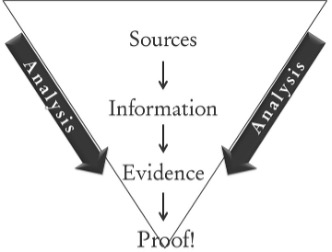
Genealogists seek answers to questions of identity and kinship, and about major life events. Successful research rests on prioritizing questions, then developing a logical, targeted plan to find reliable answers. We consult numerous sources in our quest, and it is tempting to take what we find at face value. Sources are not created equal. The information they provide is not always what it seems. If we are too trusting, information we select— evidence—can lead to incorrect conclusions or brick walls.
Genealogy Standards defines concepts of sources, information, and evidence, as well as fundamental principles for the research process.1 Source quality, independence, and diversity, combined with thoughtful, thorough analysis, are essential ingredients to genealogical success. Healthy skepticism—taking what we find with a “grain of salt”—provides the necessary seasoning for reliable conclusions that meet the Genealogical Proof Standard (GPS).2
If we cannot view originals in their textual format, we rely on facsimiles—images of originals captured on microfilm, microfiche, or as digital images. The content should be the same, but we keep in mind the limitations of the imaging process: perhaps the binding was tight and some information is hidden, or perhaps the imager accidentally skipped a few pages. Other context might be missing, such as colored inks or special instructions. We treat facsimiles as originals, but critically assess them for visual flaws. We acknowledge we might be missing a broader context.
A derivative source is one in which information has been copied, duplicated, or repeated from a previously existing source. Copies invite errors and omissions. Derivatives include word-for-word transcriptions, abstracts summarizing key information, extracts quoting select portions, and translations converting one languagto another. Derivative indexes and databases offer abbreviated information and best serve as finding aids to original sources.
Derivatives lose the context of originals. We miss the context of neighborhood associations if we confine our census search to a database entry. We miss seeing other entries on the same page of a marriage volume: marriages reported by the same official, friends or family married the same day, witnesses and consents by family or associates. Although derivatives might sometimes be our only option, they are not a suitable substitute if originals are available.
An authored narrative, published or unpublished, presents an author’s own creation, conclusions, or interpretations, usually based on multiple sources. Books, articles, websites, and online family trees are authored. They are only as reliable as the research put into them. If no sources are cited, the accuracy of the information or the validity of conclusions cannot be determined. Authored narratives that cite sources should demonstrate research depth and scope. Retrace the author’s steps by consulting the same sources: Do you concur with the author’s conclusions?
Source analysis begins during the planning phase. Appraise each prospective source for relevance and potential accuracy. Consider if sources are originals, derivatives, or authored works. Give preference to original sources.
A typical research question might ask: “When and where was Elizabeth Golden born?” A logical plan would include a birth certificate, but if the birth predates vital records, the plan must extend to other choices—perhaps church baptisms, family Bible records, death records, grave markers, or newspaper obituaries. We consult all relevant sources, staying flexible as we examine each one, altering course if necessary to accommodate what the sources tell us.
Source independence is essential to avoiding pitfalls of mistaken assumptions and inaccurate conclusions. Independent sources are unrelated to origin. The individuals providing information—the informants—are different. Select reliable, independent sources that can corroborate or credibly refute each other.
If we consult a death record, grave marker, and obituary, we must ask if these are truly independent sources, or did perhaps the same person, tasked with making final arrangements, provide information for all three. We should be skeptical of closely related sources, and continue the search for independent corroboration.
Research logs and personal research notes document relevant information about all substantive sources and images consulted, whether they provide useful information. Documentation guides ongoing analysis and provides the basis for source citations.
Standards 23–25 direct analysis and note taking during active research.3 Assess the physical quality of each source. Evaluate unique characteristics—foreign lan- guages, special notations, different inks. Note poor quality images or damaged pages—anything that limits your ability to use the source effectively. Study handwriting for accurate reading and look up legal meanings to ensure a full understanding of the document. Record all content exactly as it appears.
Standard 35 addresses internal and exter- nal consistency.4 How do parts of the source agree or disagree with each other? How does thesource compare with other items in the same series or collection? What is the provenance (origin) of the source? Who authorized its creation and for what purposes? Provenance and purpose determine what information was collected and its context, including its relevance towards answering our research question. Investigate the laws that create government records to understand their purpose. Provenance and purpose also matter for non-government sources, such as religious records.
As an example, the Golden family Bible, printed in 1867, contains three pages of births and deaths for surnames Golden, Guthrie, andWorden. Entries are in vari- ous handwritings and different colored inks. Some are too faded to read. Relationships between individuals are unstated. The earliest births date to 1819, nearly fifty years prior to the Bible’s printing. The birth of “Lisabeth Jane” Golden is recorded as 14 March 1864.5
Information is the multitude of raw data found in each source: statements of fact provided by a known or unknown informant. Just as there are different types of sources, there are different types of information. Standard 36 guides information analysis.6
Our first task here is to understand the informant. Who provided each piece of information? How did the informant acquire the information? Is the informant in a position to know the truth? Are they credible? Can they be trusted to provide accurate information to the best of their ability? A source can have more than one informant and can contain both reliable and unreliable information. The same informant might be reliable and accurate for some pieces of information but not for others.
Standard 39 assigns preference to primary information provided by a reliable informant.7 Primary information is provided by an informant with first-hand knowledge of an event. Secondary information is reported by someone who obtained it from someone else, usually reported after the fact. Undetermined information is provided by an unknown informant. It is impossible to assess the quality of information effectively without knowledge of the informant.
For example, Elizabeth (Golden) Guthrie’s death certificate contains multiple pieces of information. Three informants are identified. The attending physician provided the cause and date of death. The funeral director provided the burial date and location. Both are reliable information contributing primary information. Henry Guthrie, Elizabeth’s son, provided Elizabeth’s sex, race, occupation, marital status, and the name of her husband—all arguably primary information. He also possibly provided her age, birth date, birth location, and parentage, but Henry was not present at the time of Elizabeth’s birth. This is secondary or undetermined information.
Not all discovered information relates to our research question. Evidence is the relevant information found in a source that tentatively answers our question. Direct evidence is information that by itself answers the research question. Indirect evidence must combine with evidence from other sources. Taken together, they answer the research question . Negative evidence is a situation wherein the absence of information is itself evidence. Standards 37–46 address reasoning from evidence.8
A source may provide more than one type of evidence. Evidence may come from information naming relatives, associates, or other persons of interest. Evidence may come from information not naming specific individuals, but through studies of history, demographics, culture, or law.
Standard 45 cautions that evidence should make sense.9 Fundamental assumptions are concepts generally accepted as objectively true. Actions taken after an individual’s documented death are obviously incompatible with physical reality. Valid assumptions are concepts generally accepted as true unless compellingly contradicted. It is reasonable to suppose an eighty-year old woman is too old for childbearing.
Unsound assumptions are concepts that may be valid, but require corroborating evidence. Is Mary named in your ancestor’s will the same Mary identified as his wife forty years earlier? Remain flexible with name variants and minor inconsistencies in spellings, dates, and locations, but be skeptical of individuals of the same name, in the same time frame, but in different localities or circumstances.
Analyzing evidence requires careful attention to detail. We objectively compare and contrast evidence from each source, evaluating for relevance, reliability, and consistency. Information that initially seems insignificant may contribute evidence when combined with other findings. We do not alter or ignore evidence to accommodate our own assumptions or biases, or to conform with other pieces of evidence. Be selective. Set aside evidence that seems irrelevant or unreliable. Justify your choices.
Family Bible entries offer indirect evidence of Elizabeth’s parents. Sarah Worden and Jacob Golden are the right ages, but their relationship is unstated. Both are named as Elizabeth’s parents on her death certificate: direct evidence, but secondary information.10 Corroboration comes from Elizabeth’s marriage to An-drew Guthrie. The state-level record states Jacob Golden, father of the bride, consented to the marriage. Elizabeth’s parents are identified there as Sarah Worden and Jacob Golden. Jacob, a reliable informant probably provided this primary information.11
As each round of research and analysis is completed, correlate the evidence. Major disagreements must be addressed and resolved before reaching a conclusion. Proof rests on reliable, compatible evidence derived from diverse, independent sources. Thoughtful source selection and critical analysis, seasoned with judicious “grains of salt,” are keys to genealogical evidence.
Publication dates and website links were updated as of 3 October 2025.
- Board for Certification of Genealogists, Genealogy Standards, 2nd , rev. (Nashville: Ancestry.com, 2021).
- Ibid., pp. 1–3.
- Ibid., p. 17
- Ibid., p. 21
- Golden family Bible records, 1819–1912, The Holy Bible (New York: American Bible Society, 1867); privately held by the author.
- Genealogy Standards, p. 22.
- Ibid., p. 24.
- Ibid., pp. 23–27.
- Ibid., p. 26.
- Golden family Bible records, Golden-Worden entries. Also, Iowa, death certificate, Poweshick County, 174, Eliabeth J. Guthrie (1932); State Historical Society, Des Moines.
- Iowa, Return of Marriages in the County of Mahaska, 304:705, Guthrie–Golden (1881); digital image, “Iowa, U.S., Marriage Records, 1880-1945,” Ancestry (ancestry.com : accessed 8 April 2022).